
Innnovation
Follow the Friction: Where the Caribbean Innovation Economy’s Next Big Businesses Are Hiding


The most profitable opportunities in the Caribbean and Diaspora innovation economy are the ones nobody wants to talk about.
There are some very boring infrastructure gaps in the Caribbean and Diaspora Tech and Innovation economy, and they can be filled very profitably.
We spend far too much time looking in the obvious places. Everybody wants to build the sexy thing. The next AI startup. The next fintech. The next consumer app. The next big platform. There are opportunities there. I’m not pretending otherwise.
But the biggest opportunities are hiding in the layers underneath – the infrastructure that makes everything else work.
The boring stuff.
And boring is where the money is.
Start with payments
In 2025, Jamaicans abroad sent home US$3.49 billion. A record, according to the Bank of Jamaica, and somewhere between 15 and 17 per cent of the country’s GDP. Across Latin America and the Caribbean, the Inter-American Development Bank puts the 2025 figure at roughly US$174 billion.
Now the part nobody puts on a conference slide: the World Bank’s global average cost of sending a remittance is 6.36 per cent. Through a bank, it averages nearly 15 per cent. The UN’s target is 3 per cent.
Do the arithmetic on Jamaica alone. Every percentage point of friction on US$3.49 billion is roughly US$35 million a year — money that leaves the diaspora’s pocket and never reaches a Jamaican household.
That is not a small problem dressed up as a big one. That is one of the largest recurring cash flows in the region, and a meaningful slice of it is being eaten by the plumbing.
And remittances are only the consumer end of it. A Jamaican company invoicing a client in Trinidad, a Barbadian consultant collecting from a firm in London, a Guyanese supplier paid by a buyer in Miami – all of that moves through the same fragmented, expensive, slow rails.
When you make cross-border payments, collections, and commerce easier for those people, and you haven’t built a product. You’ve built infrastructure that other businesses depend on.
Then talent
The Caribbean has an enormous pool of developers, designers, marketers, operators, creatives and specialised professionals – at home and across the diaspora.
What it doesn’t have is the infrastructure connecting that talent to global demand.
Picture a platform where a company anywhere can discover verified Caribbean talent, understand their skills and experience, hire them, manage contracts and payroll, handle payments, and deal with compliance in one place.
That’s not another job board.
That’s talent infrastructure.
And it gets genuinely interesting the moment you stop thinking about the Caribbean as fifteen small labour markets and start treating it as one global talent supply network.
Then logistics
Moving goods around the Caribbean – and between the Caribbean and the diaspora- is absurdly fragmented.
A small business in Jamaica that wants to sell into Barbados, Trinidad, Miami or London has to solve shipping, freight forwarding, customs, warehousing, last-mile delivery, returns and payments across a different set of providers and systems for every market. Most of them give up and stay domestic. That’s not a talent problem or an ambition problem. That’s an infrastructure tax.
So build the layer that makes Caribbean commerce move.
You don’t need to own trucks, planes, or ships. You aggregate shipping capacity. You connect freight providers. You handle documentation and customs workflows. You provide shipment visibility, consolidate orders, and make it possible for one Caribbean business to sell and fulfil across five markets without hiring a logistics department.
Become the layer that makes it easier and cheaper for thousands of businesses to move things, and you take a piece of every transaction.
Which brings me to something worth saying plainly:
You don’t have to own the infrastructure to make money from the infrastructure.
Often you just need to make the fragmented pieces work together.
The shape underneath all of it
Notice what payments, talent and logistics have in common.
The Caribbean is full of fragmented supply- independent professionals, event producers, accommodations, tour operators, creatives, manufacturers, food producers, wellness practitioners, technology companies, venues, suppliers, specialised services.
The supply exists. The problem is that it’s hard to discover, compare, trust, transact with, and buy from.
That’s the pattern. And the opportunity is never “build another website where people list things.” It’s owning the sequence around the transaction:
Discovery → verification → matching → payment → fulfilment → reputation.
Whoever owns that sequence in a given sector owns the sector. That’s true in payments, in talent, in logistics, and in the one I’m about to describe.
And media
The Caribbean produces an enormous amount of culture, information, expertise and creative work. The infrastructure for discovering, organising, distributing and monetising it at scale barely exists.
A Caribbean creator, publisher, podcast, event producer or niche media brand can have an audience across Kingston, Toronto, London, Miami and New York – and no serious system connecting that audience to advertisers, sponsors, commerce or events. The monetisation is still hand-to-hand combat: one founder, one inbox, one sponsor at a time.
So build the commercial infrastructure layer for Caribbean digital media.
A network that aggregates quality Caribbean and diaspora publishers and creators. Packages their audiences for advertisers and sponsors. Provides market intelligence. Runs campaigns and payments. Helps smaller media companies earn beyond selling individual ads.
You’re not trying to become the next big media company. You’re building the infrastructure that helps hundreds of small Caribbean media businesses make more money -and monetising across media buying, subscriptions, sponsorships, data, events, commerce and technology.
Become the layer that helps a fragmented market find its audience, sell its audience and understand its audience, and you’ve built something valuable.
Fragmentation is the opportunity. It always was.
The pattern
Payments.
Talent.
Logistics.
Media.
Data.
Procurement.
Business services.
Capital.
Distribution.
None of these are generating hype right now. All of them are what makes an economy function.
I’ve spent nearly twenty years watching the Caribbean innovation space, and here’s what I keep noticing:
There is a huge gap between what gets attention and where the opportunity is.
Hype follows visibility. Money follows friction.
The opportunity is sitting inside the annoying, expensive, inefficient thing everyone has quietly accepted as:
“That’s just how things work around here.”
That’s where I’d be looking.
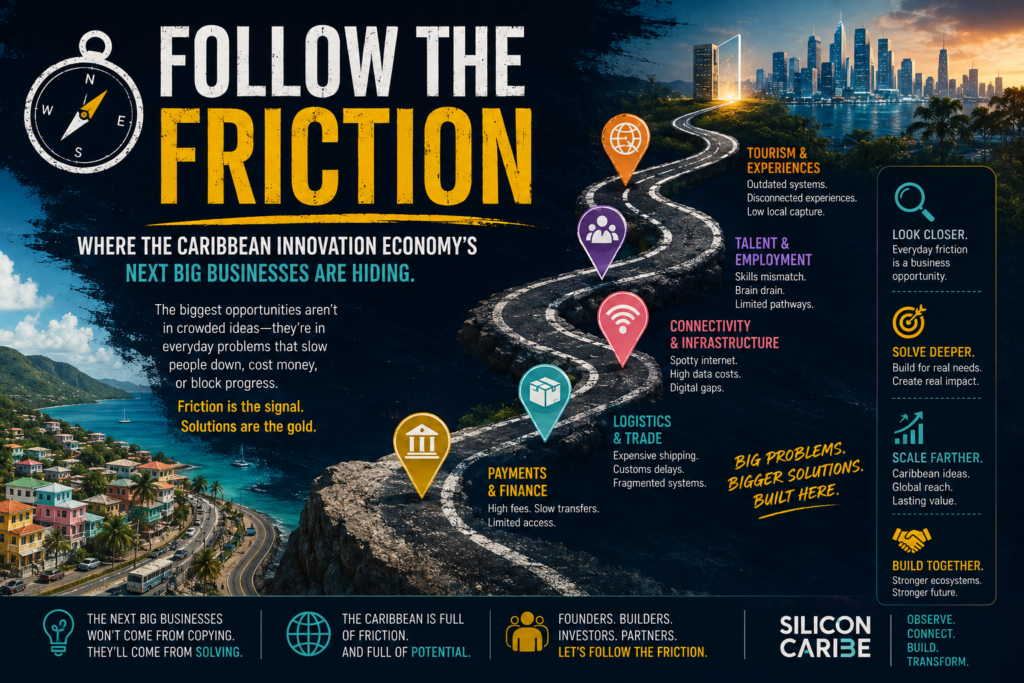
So what do you actually do with this?
Don’t start by building an app. That’s the first mistake and it’s an expensive one.
Start by finding the friction.
Pick one sector. Spend 30 days talking to the people inside it. Ask:
- What is unnecessarily difficult?
- What do you do manually, over and over?
- Where are you losing money?
- What takes too long?
- What requires three or four different companies to accomplish?
- What can’t you easily find?
- What can’t you easily trust?
- What do you have to do outside the Caribbean because the infrastructure doesn’t exist here?
- What problem gets worse as you grow?
Then look for a problem with frequency + money + fragmentation. If it happens often, costs real money, and shows up across multiple markets or businesses – pay attention.
Then don’t build the whole thing.
Build the smallest possible transaction.
Can you manually match one Caribbean company with one buyer?
Can you manually place one Caribbean professional with one global company?
Can you facilitate one cross-border payment?
Can you aggregate one category of suppliers into one trusted marketplace?
Can you help one Caribbean media company sell a campaign to a global brand?
Do it by hand first. Get somebody to pay you before you spend six months building technology.
The goal isn’t to prove you can build a platform. The goal is to prove somebody will pay for the solution.
Then build the technology around the transaction that’s already working.
That’s how you turn an infrastructure gap into a business.
And yes, I know what some of you are thinking.
“Okay Ingrid, but where are the actual opportunities? Give us the whole blueprint.”
😂
No.
I’m giving you the door. You still have to walk through it.
There’s real fun in the digging – researching markets, talking to people, finding the weird little inefficiencies, following the money, connecting unrelated dots, and suddenly realising:
“Holy shit. There’s a business here.”
That’s the part I love. And if I handed you the whole blueprint, you’d miss the most valuable part anyway: learning to see the opportunity yourself.
So go digging. Look underneath the hype. Follow the friction. Talk to the people doing the boring work. Connect the dots.
And when you find something?
Build it.
There are plenty of people chasing the sexy opportunities.
Good.
More room for the ones who see things differently.
Somebody’s going to stack cash there.
Ingrid Riley is the Founder & Chief Writer of this globally syndicated SiliconCaribe® blog. She is an award-winning entrepreneur who has produced over 300+ Tech Events across 15 Caribbean and Diaspora cities + Media. Communities. Platforms for the Global Caribbean Tech & Innovation Economy.
Never miss an event, profile, or story about the global Caribbean tech and Innovation Economy. Subscribe to the free SiliconCaribe Weekly newsletter.





-
Trends16 years ago
376,580 Trinidadians now on Facebook, 40% of their population Online.
-
Trends16 years ago
Jamaicans pour unto Facebook 429,160 now on the social network
-
Trends16 years ago
JamaicaObserver.com steps it up again with Social Media Plugins
-

 eCommerce3 years ago
How Amazon.com Shipped Directly To My door in Jamaica, Finally!