Creator Economy
The Caribbean’s Next Big Export Isn’t Music or Tourism. It’s Attention.

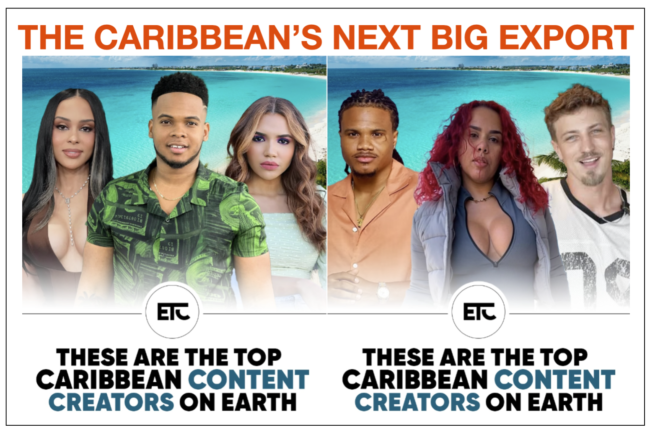
More than 300 million people follow these top 36 Caribbean creators. The region’s most valuable digital export may no longer be culture itself-but the global attention it commands.
For decades, the Caribbean has exported the things the world already recognizes.
Music. Tourism. Athletics. Food. Culture.
Those industries have shaped the region’s global identity and generated billions in economic activity.
But there’s another export quietly emerging-one that few governments measure, few investors finance, and few development agencies even acknowledge.
The Caribbean is exporting attention.
And it may become one of the region’s most valuable digital assets.
The Numbers Tell a Different Story
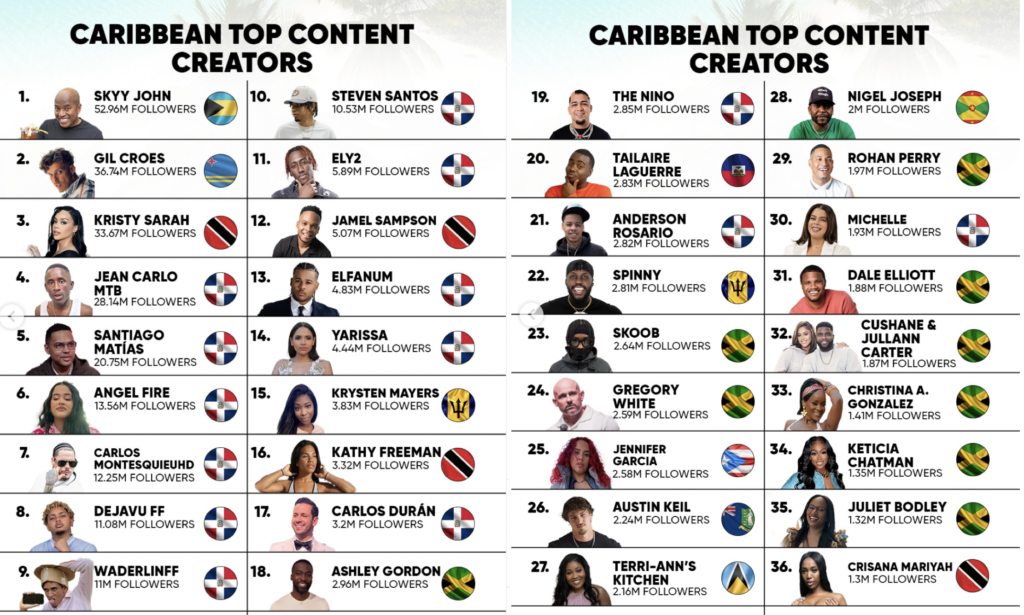
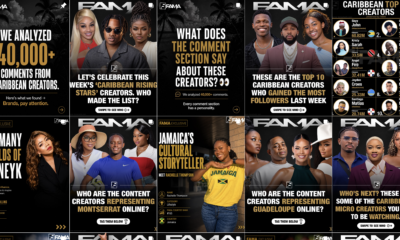
A recent analysis by Explaining the Caribbean-an Instagram-based intelligence platform covering the region’s society, economy, business, culture, and politics-reveals a creator economy operating at a scale that deserves far more global recognition.
Its Top 36 Caribbean Creators dataset paints a picture that challenges long-held assumptions about the region’s place in global media.
Bahamian creator Skyy John tops the list with a combined audience of 52.96 million followers and subscribers across major non-paywalled platforms.
He is followed by Aruba’s Gil Croes with 36.74 million, and Trinidad and Tobago’s Kristy Sarah with 33.67 million.
The Dominican Republic dominates much of the ranking with creators including Jean Carlo MTB (28.14 million), Santiago Matías (20.75 million), Angel Fire (13.56 million), and Carlos MontesquieuHD (12.25 million).
These aren’t follower counts from a single platform. They represent combined audiences across YouTube, Instagram, TikTok, Facebook, and other major platforms.
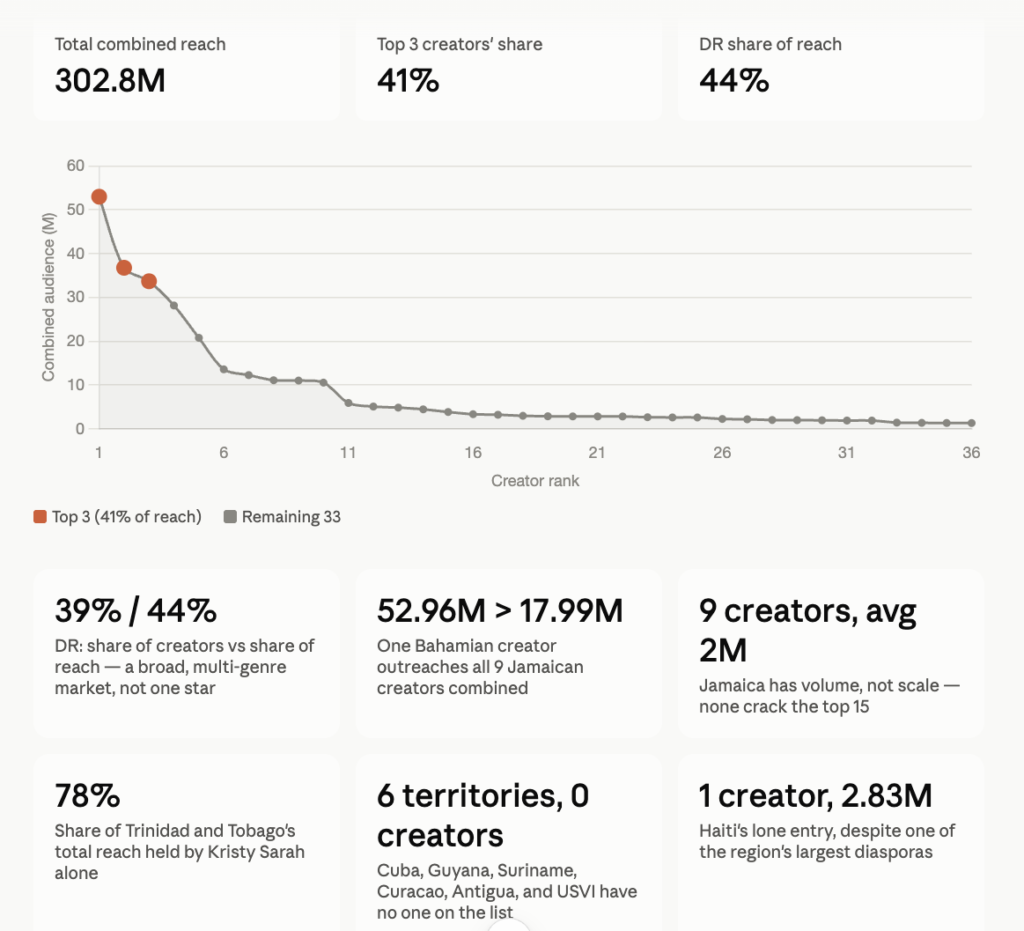
Taken together, these creators command an audience of more than 300 million people.
That’s larger than the population of most countries.
We Keep Asking the Wrong Question
For years, conversations about the Caribbean creator economy have centered around one question:
How do we build the Caribbean’s next MrBeast?
The data suggests we’re asking the wrong question.
The better question is:
Why are we acting like global Caribbean creators don’t already exist?
The Caribbean creator economy isn’t an emerging opportunity.
It’s already global.
Our institutions, brands, investors, and policymakers haven’t caught up.
Attention Has Become an Export
The creator economy isn’t really about followers.
It’s about attention.
Every day, millions of people around the world wake up and consume content created by Caribbean storytellers, entertainers, educators, chefs, comedians, gamers, beauty creators, and media personalities.
That attention generates advertising revenue and can generate much more:
Brand partnerships.
Affiliate sales.
Merchandise.
Subscriptions.
Live events.
Licensing deals.
Digital products.
Intellectual property.
In the digital economy, attention is a resource.
And like tourism or music before it, the Caribbean has become a significant exporter of it.
The difference is that we’re still treating it as a hobby rather than an industry.
The Dominican Republic Has Quietly Built the Region’s Deepest Creator Economy
Perhaps the most striking insight from the dataset isn’t who ranks first.
It’s how the Dominican Republic dominates the list.
Fourteen of the Top 36 creators-nearly 40%-are Dominican.
Together they command roughly 133 million followers, accounting for about 44% of the combined reach of everyone on the list.
More importantly, the Dominican Republic hasn’t produced just one superstar.
It has built depth.
Creators spanning comedy, entertainment, lifestyle, media, and sports have built audiences ranging from three million to nearly thirty million followers.
That’s what a mature creator ecosystem looks like.
Population Doesn’t Predict Digital Influence
One of the most surprising findings challenges conventional assumptions about market size.
Aruba has a population of just over 100,000 people.
Yet Gil Croes alone reaches more than 36 million followers.
Skyy John, from The Bahamas, commands a larger audience than the combined reach of all nine Jamaican creators appearing in the ranking.
Digital media has fundamentally changed the economics of geography.
The size of your island no longer determines the size of your audience.
Jamaica Has Participation. It Still Needs Scale.
Jamaica places nine creators on the list-second only to the Dominican Republic.
That reflects strong participation in the creator economy.
But none break into the Top 15, and the country’s combined reach sits below expectations given Jamaica’s extraordinary global cultural influence.
The obvious question is why.
How has Jamaica become one of the world’s most influential exporters of music, language, fashion, and culture, yet not produced a creator with the same global scale seen elsewhere in the region?
That’s a question worth investigating.
The Winners Are Pulling Away
Like every digital platform economy, the creator economy follows a power law.
The top three creators account for approximately 41% of the total audience represented in the dataset.
A small number of creators capture an outsized share of global attention, while thousands compete for what’s left.
This isn’t unique to the Caribbean.
It’s how YouTube, TikTok, Instagram, podcasts, newsletters, and streaming platforms all work.
Which makes one thing clear:
Building creator businesses isn’t simply about producing more creators.
It’s about helping them scale.
The Bigger Story Is What’s Missing
Perhaps the most important insight isn’t who’s on the list.
It’s who isn’t.
Only one creator represents Haiti.
One comes from Grenada.
One from Saint Lucia.
One from Puerto Rico.
One from the British Virgin Islands.
There are no creators on Explaining the Caribbean’s Top Creator List from Guyana, Suriname, Cuba, Curaçao, Antigua and Barbuda, or the U.S. Virgin Islands.
That raises difficult but necessary questions.
Are these countries underrepresented because creator ecosystems haven’t developed?
Because monetization infrastructure is weak?
Because platform discovery favors larger markets?
Or because nobody has seriously measured them before?
Those questions deserve answers.
The Caribbean Doesn’t Have a Creator Problem
It has an infrastructure problem.
More specifically, it has a recognition problem.
Consider what doesn’t exist across most of the region.
Which Caribbean banks actively finance creator businesses?
Which investors specialise in creator-led companies?
Which governments have national creator economy strategies?
Which universities teach creator entrepreneurship?
Which investment agencies treat creators as export businesses?
Which Caribbean brands consistently allocate significant advertising budgets to regional creators instead of the usual suspects?
The answers reveal the gap.
The Caribbean is producing globally competitive creators.
What it hasn’t produced-at least not at scale-is the ecosystem around them.
Talent agencies.
Creator funds.
Management companies.
IP specialists.
Analytics firms.
Production studios.
Brand marketplaces.
Cross-border payment infrastructure.
Education.
Investment.
Policy.
That’s where the next wave of opportunity lies.
The Real Opportunity
For years, the Caribbean has debated how to diversify beyond tourism.
The creator economy offers one answer hiding in plain sight.
Not because every young person should become an influencer.
But because audiences have become economic assets.
Every subscriber represents attention.
Every view represents demand.
Every creator business represents intellectual property that can be monetized globally without exporting a physical product.
The Caribbean isn’t just exporting beaches anymore.
It isn’t just exporting music.
It isn’t just exporting culture.
It’s exporting attention.
The question is no longer whether the Caribbean has world-class creators.
The data shows that it does.
The real question is whether the region is prepared to build an economy around them before the rest of the world recognizes what has been hiding in plain sight all along.
Ingrid Riley is the Founder & Chief Writer of this globally syndicated SiliconCaribe® blog. She is an award-winning entrepreneur who produces Events. Media. Communities. Platforms for the Global Caribbean Tech & Innovation Economy.
Never miss an event, profile, or story about the global Caribbean tech and Innovation Economy. Subscribe to the free SiliconCaribe Weekly newsletter.



-
Trends16 years ago
376,580 Trinidadians now on Facebook, 40% of their population Online.
-
Trends16 years ago
Jamaicans pour unto Facebook 429,160 now on the social network
-
Trends16 years ago
JamaicaObserver.com steps it up again with Social Media Plugins
-

 eCommerce3 years ago
How Amazon.com Shipped Directly To My door in Jamaica, Finally!