
Creator Economy
Somebody Finally Built the Scoreboard: FAMA and the Measuring of Caribbean Creator Culture

A Jamaican data scientist has built the region’s first weekly creator chart. It ranks 200 Caribbean creators across 33 territories – and it quietly solves the problem that has kept brand money out of the regional creator economy for a decade.
The Caribbean has never had a shortage of creators. It has had a shortage of proof.
Ask a regional brand manager to justify a five-figure campaign with a Caribbean creator and watch what happens. There is no chart to point at. No verified audience figure. No ranking, no trend line, no way to say this person is the 14th-largest creator in the region and grew 100,000 followers last week. What exists instead is a screenshot of an Instagram analytics tab and a lot of vibes.
FAMA is the fix.
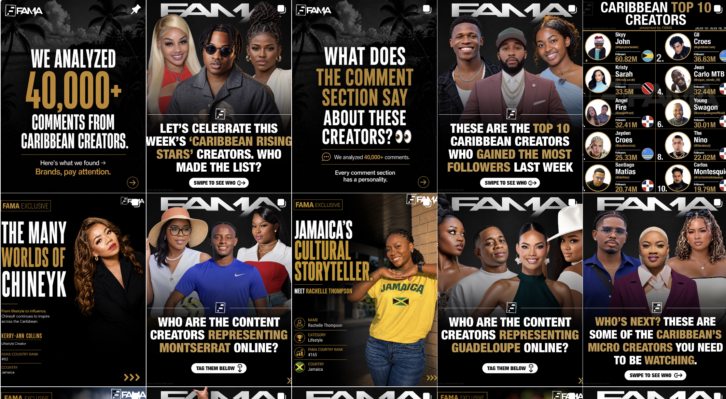
Launched by a Jamaican data scientist and living at famacharts.com and on Instagram @famachartsofficial, FAMA describes itself simply as the home of Caribbean creators: a place where fans and brands discover talent, and where rankings, milestones and highlights get tracked week over week. It is Billboard logic applied to Caribbean creator culture – and it is the piece of infrastructure the region has been missing.
What it actually does
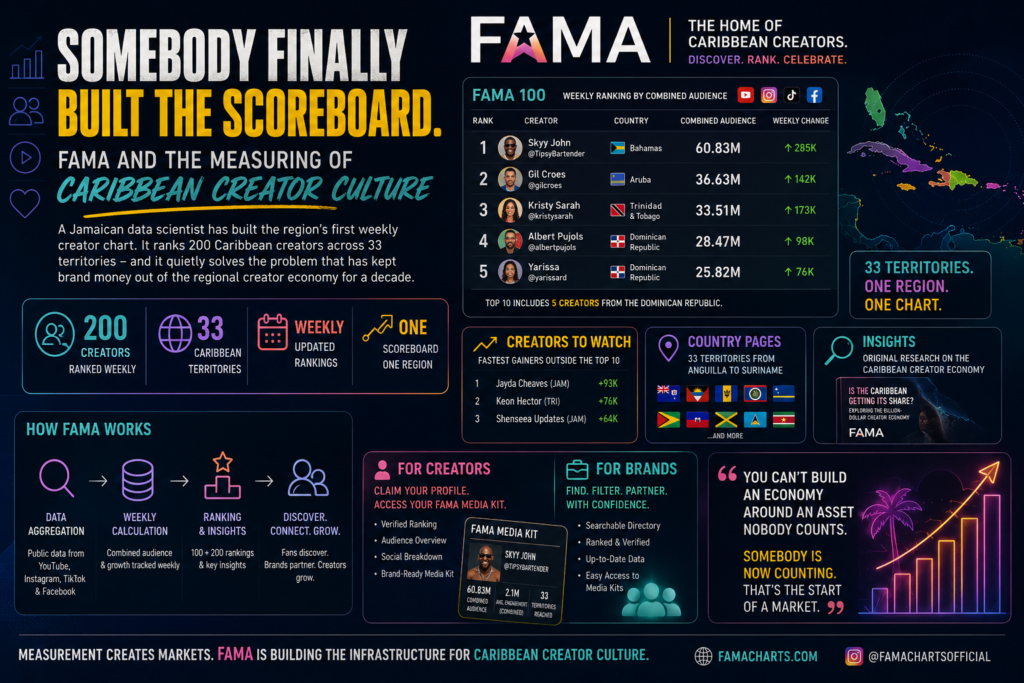
The core product is the FAMA 100, a weekly ranking of Caribbean creators by combined audience across YouTube, Instagram, TikTok and Facebook, built from publicly available profile data and refreshed every week. A FAMA 200 extends the field. A Creators to Watch module surfaces the fastest week-over-week gainers outside the top 10 -the region’s early-warning system for who is breaking next.
The current top of the chart is a useful corrective to anyone still thinking of Caribbean creators as a small market. Bahamian lifestyle creator Skyy John (@TipsyBartender) leads with a combined 60.83 million. Aruba’s Gil Croes sits second at 36.63 million. Trinidad and Tobago’s Kristy Sarah is third at 33.51 million. The Dominican Republic dominates the top 10 with five entries. Aruba, population roughly 100,000, has two.
Around the charts, FAMA has built the rest of a media property: country pages spanning 33 territories from Anguilla to Suriname, a Feed running original creator profiles, and an Insights section publishing industry research – its first report asking whether the Caribbean is getting its share of a creator economy now worth billions.
The business model hiding in plain sight
The most interesting page on FAMA is not the chart. It is the join page.
Creators can sign up, claim their profile, and – the operative phrase – access their FAMA media kit. Brands get a searchable, ranked, weekly-updated directory of Caribbean talent. Creators get a third-party credential they can put in front of an advertiser.
That is a two-sided marketplace, and it is a smarter position than either side alone. Rankings generate attention and cultural authority. Claimed profiles generate a creator database. Media kits generate the document that a brand’s procurement process actually requires. Whoever owns the measurement layer of a market ends up sitting between the buyers and the sellers of that market – which is exactly how Billboard, Nielsen, and Chartmetric built durable businesses on top of what looked, at first, like a list.
What it still has to prove
Followers are the easy metric, not the right one. Combined follower count is where every ranking starts because it is the only number that is publicly scrapeable. But brands buy engagement, conversion, and audience geography, not raw totals. A creator with 30 million followers who converts nothing is worth less than one with 300,000 who sells out a product drop. The chart that adds engagement rate and audience location becomes a genuine buying tool rather than a leaderboard.
Curation is a methodology risk. FAMA states plainly that it tracks a curated roster and invites the public to suggest creators. That is honest – and it means the chart measures who FAMA knows about. The francophone and Dutch Caribbean, in particular, will test whether the roster is truly regional or quietly anglophone-first.
Authorship matters. FAMA currently runs without a public founder byline. For a platform whose entire value is trust in its numbers, the person and the method behind the data are an asset, not a detail. Name the data scientist. Publish the methodology in full. Credibility compounds.
Why this matters now
Our position on this has been consistent: the Caribbean’s next major export is attention, and the region has been giving it away unmeasured and unpriced. You cannot build an economy around an asset nobody counts.
Somebody is now counting. That is not a small thing – it is the start of a market.
Ingrid Riley is the Founder & Chief Writer of this globally syndicated SiliconCaribe® blog. She is an award-winning entrepreneur who has produced over 300+ Tech Events across 15 Caribbean and Diaspora cities + Media. Communities. Platforms for the Global Caribbean Tech & Innovation Economy.
Never miss an event, profile, or story about the global Caribbean tech and Innovation Economy. Subscribe to the free SiliconCaribe Weekly newsletter.






-
Trends16 years ago
376,580 Trinidadians now on Facebook, 40% of their population Online.
-
Trends16 years ago
Jamaicans pour unto Facebook 429,160 now on the social network
-
Trends16 years ago
JamaicaObserver.com steps it up again with Social Media Plugins
-

 eCommerce3 years ago
How Amazon.com Shipped Directly To My door in Jamaica, Finally!