
Digital Trends
The Caribbean Gets Another Intelligence Layer: Inside Explaining the Caribbean, the Region’s Newest Digital-First Media Brand

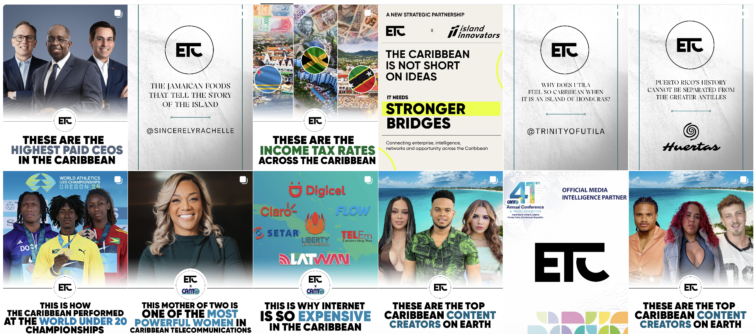
Explaining the Caribbean has pulled 21 million views and 72,000 followers, explaining the region to the world. Now it wants to be the knowledge infrastructure governments and investors reach for first.
There is a version of Caribbean media that has been running on repeat for fifty years: the postcard or the crisis. Turquoise water or a hurricane track. Very little in between.
Explaining The Caribbean – ETC – was built to occupy the in between.
The brand launched as a social-first publisher and has grown into something with a more ambitious label attached to it: The Caribbean Intelligence Platform. Its output is deceptively simple – sharply designed, data-led explainers on Instagram, TikTok and LinkedIn covering society, economy, business, culture and politics across all Caribbean territories. Its stated ambition is considerably less simple. ETC says it is building “the definitive knowledge layer for the Caribbean,” a reference point for governments, businesses, researchers and the globally curious.
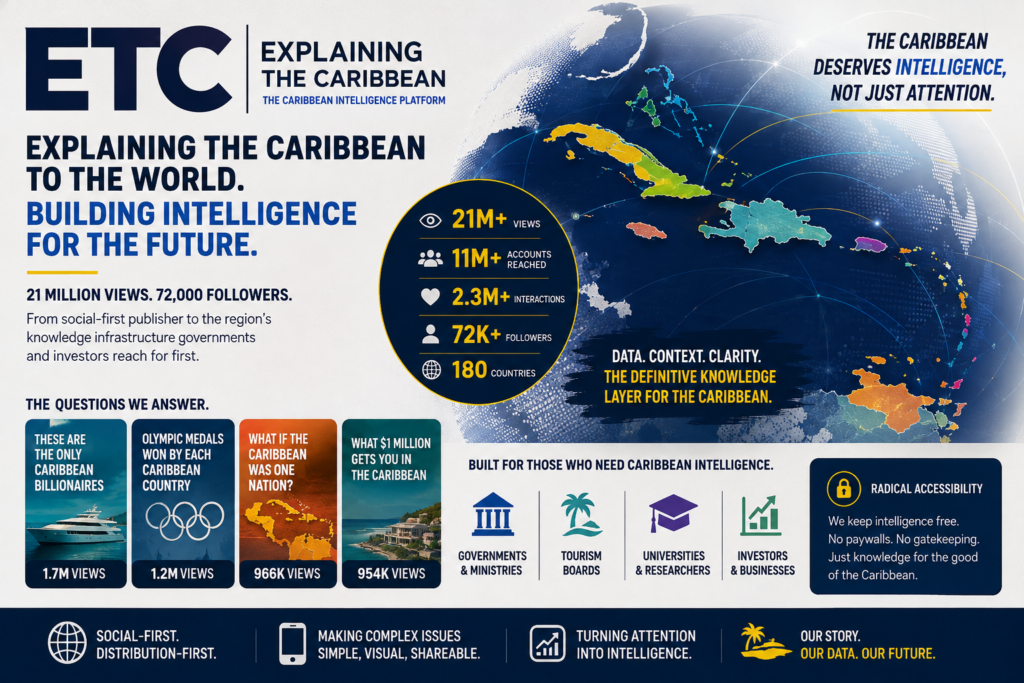
The numbers suggest the market was waiting for it. ETC reports 21 million-plus views, 11 million accounts reached, 2.3 million interactions and 72,000 followers, with readers in 180 countries. Its best-performing pieces are the kind of questions the region asks itself constantly and rarely sees answered with a chart: These Are The Only Caribbean Billionaires (1.7M views). Olympic Medals Won By Each Caribbean Country (1.2M). What If The Caribbean Was One Nation? (966K). What $1 Million Gets You In The Caribbean (954K).
The distribution-first playbook
What makes ETC worth studying isn’t the content. It’s the build order.
Legacy Caribbean media built the publication first and chased distribution afterward – a website, then a Facebook page, then a scramble for reach that mostly never came. ETC inverted it. The audience came first, on platforms where Caribbean attention already lives, in a format the algorithm rewards. The website, launched with an institutional-grade brand identity and a partnerships page, arrived once there was something to monetise.
That sequencing matters for every founder in the regional creator and media economy. Audience and attention are now the assets that get built first and the ones everything else is financed against. ETC is a clean case study of the model working in a Caribbean context, at a scale most regional outlets have never touched.
The business underneath
ETC’s revenue thesis is visible in its site architecture. The platform names four constituencies it serves: governments and ministries, tourism boards, universities and researchers, and investors and businesses. Those are not consumer segments. They are B2B accounts with procurement budgets, research needs, and a chronic shortage of credible regional data.
It is, in effect, a media brand positioning itself as a research and intelligence business – closer to a Statista or a Chartbook than to a magazine. The consumer audience is the credibility engine and the top of the funnel; institutions are where the money is.
Notably, ETC has committed publicly to keeping the intelligence free, listing “radical accessibility” among its core values and explicitly rejecting paywalls and academic journal gating. That is a defensible choice if partnerships, sponsorship and commissioned research carry the P&L. It is a hard one if they don’t.
The open questions
Three things will determine whether ETC becomes infrastructure or stays a very good account.
Depth. A 60-second explainer and a research product are different animals. Governments buying policy intelligence will want methodology, sourcing and reproducibility. ETC says it collaborates with regional statistical agencies and international institutions – the proof will be in whether it publishes datasets, not just carousels.
Platform risk. Twenty-one million views sitting on rented land is a strategic vulnerability. The move to owned properties has begun; how fast it converts followers into a direct audience is the number to watch.
Authorship. ETC currently speaks in the institutional voice – “the platform,” “we” – with no founder or editorial team named publicly. That works for a brand claiming neutrality. It works less well for one asking ministries and investors to treat it as a primary source. Institutions buy from people.
None of that dulls the point. For two decades the complaint has been the same: the Caribbean is under-documented, under-explained and under-priced because the world does not understand what it is looking at. ETC has decided to fix that as a business, and it has the initial distribution to be taken seriously.
The Caribbean deserves intelligence, not just attention. That is ETC’s line. It should probably be the whole region’s.
Much success to you Gianni Love, the Jamaican-American founder of ETC.
Ingrid Riley is the Founder & Chief Writer of this globally syndicated SiliconCaribe® blog. She is an award-winning entrepreneur who has produced over 300+ Tech Events across 15 Caribbean and Diaspora cities + Media. Communities. Platforms for the Global Caribbean Tech & Innovation Economy.
Never miss an event, profile, or story about the global Caribbean tech and Innovation Economy. Subscribe to the free SiliconCaribe Weekly newsletter.






-
Trends16 years ago
376,580 Trinidadians now on Facebook, 40% of their population Online.
-
Trends16 years ago
Jamaicans pour unto Facebook 429,160 now on the social network
-
Trends16 years ago
JamaicaObserver.com steps it up again with Social Media Plugins
-

 eCommerce3 years ago
How Amazon.com Shipped Directly To My door in Jamaica, Finally!